| After the General Chapter of 1976,
there were changes in the administrative system of the
Institute. No more "Brother Assistant," but "Brother Regional" who
administered several Districts in a vaster geographic region.
|
|
III. From 1890 to 1954
A. Administration of the Institute in the Asia Region
List of Brothers Assistant in charge of the Asia Region:
. ...
. 1875 - 1880 : Brother Assistant Agapet
. 1882 - 1906 : Brother Assistant Aimarus
. 1907 - 1913 : Brother Assistant Imier de Jésus
. 1913 - 1920 : Brother Assistant Anthime Louis
. 1920 - 1946 : Brother Assistant Arèse Casimir
. 1946 - 1956 : Brother Assistant Zacharias
. 1956 - 1966 : Brother Assistant Lawrence O'Toole.
| After the General Chapter of 1976,
there were changes in the administrative system of the
Institute. No more "Brother Assistant," but "Brother Regional" who
administered several Districts in a vaster geographic region.
|
|
In Asia, from 1866 to 1895, the District of Indochina was integrated into the District of India. In 1896, the District of Indochina is separated from the District of India, becomes autonomy, and is then named District of Saigon.
List of Brother Visitors in charge of the District of India and the District of Saigon from 1866 to 1895:
- District of India and District of Indochina:
. 1866 - 1872 : Brother Jaime
. 1873 - 1877 : Brother Lothaire-Marie
. 1878 - 1888 : Brother Idinaélis
. 1888 - 1893 : Brother Bernard-Louis
. 1893 - 1895 : Brother Abban
- District of Indochina, aka District of Saigon
. 1896 - 1912 : Brother Ivarch-Louis
. 1913 - 1920 : Brother Albin-Camille
. 1920 - 1925 : Brother Aglibert-Marie
. 1925 - 1926 : Brother Christophe-Léon
. 1926 - 1933 : Brother Divy-Joseph
. 1933 - 1936 : Brother Dominique-Marie
. 1936 - 1942 : Brother Donatien-Jules
. 1942 - 1951 : Brother Domicé-Rogatien
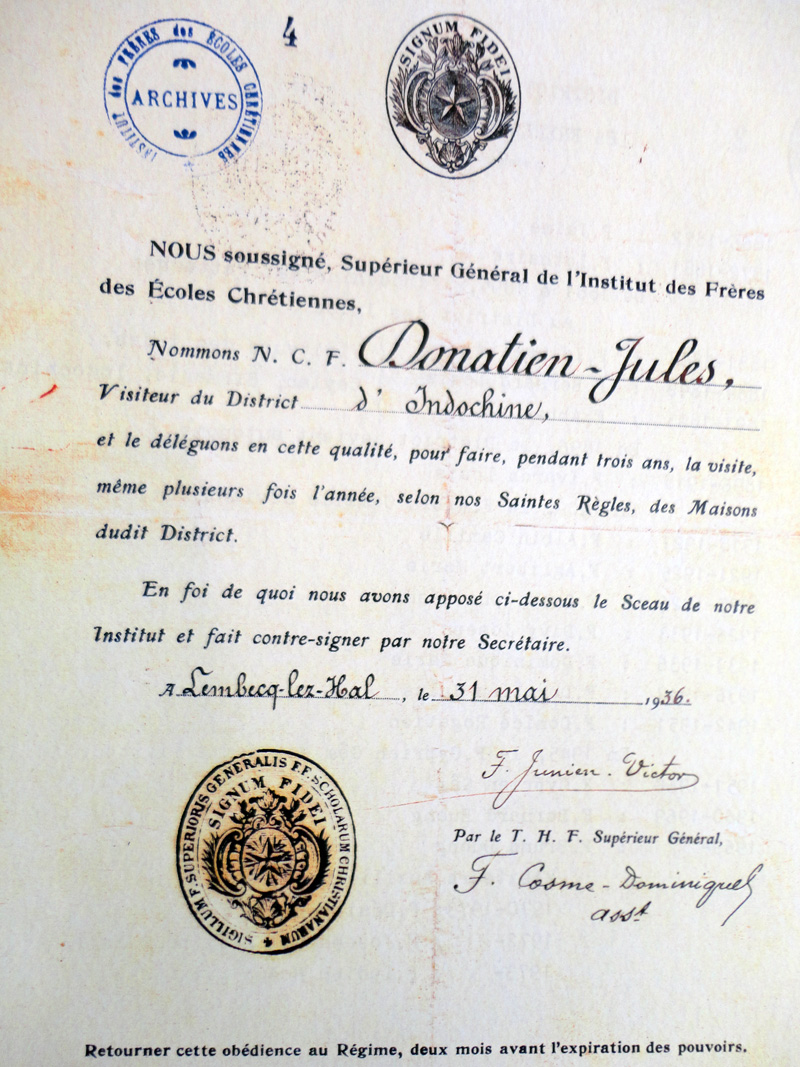
Brother Superior General Junien-Victor assigned Brother Donatien-Jules as
Visitor of the District of Indochina
[assignment signed on May 31, 1936 from Lembecq-les-Hal (then Mother House in
Belgium]
***
B. Documents 17450 - D8 f2
"The Brothers of The Christian Schools returned to Saigon in 1889,
and fully conduct the school of Taberd.
From Saigon, the Brothers extend their apostolic works every where in the land
of Indochina which compose of 21 millions habitants and which is as large as
about 720,000 kilometers square...
... The Brothers from An-Nam were well formed
so that they can help and assist effectively their French Brothers in the common
apostolic field.
... Many of students from the schools of the Brothers are chosen for different
offices of the French government...
... The Brothers welcome every student, regardless of religion or faith.
However, no one is dispensed of the catechism taught in class. It is interesting
to find out that many students from other religions/faiths are more committed to
religious studies and get more points and first grades or rewards than those of
Christian or Catholic students."
The need of education is more and more urgent. The number of Brothers from France ("Mother Country") is also so limited that the Superiors cannot send anyone to help the country in Mission. In addition, the missionary Brothers from France work hard, too hard even since they have to adapt to the life style of indigene people which is so different from theirs at home: poverty, sanity, climate, and environment... All is totally if not quite different. It indeed affects mental and biological health and many other problems.
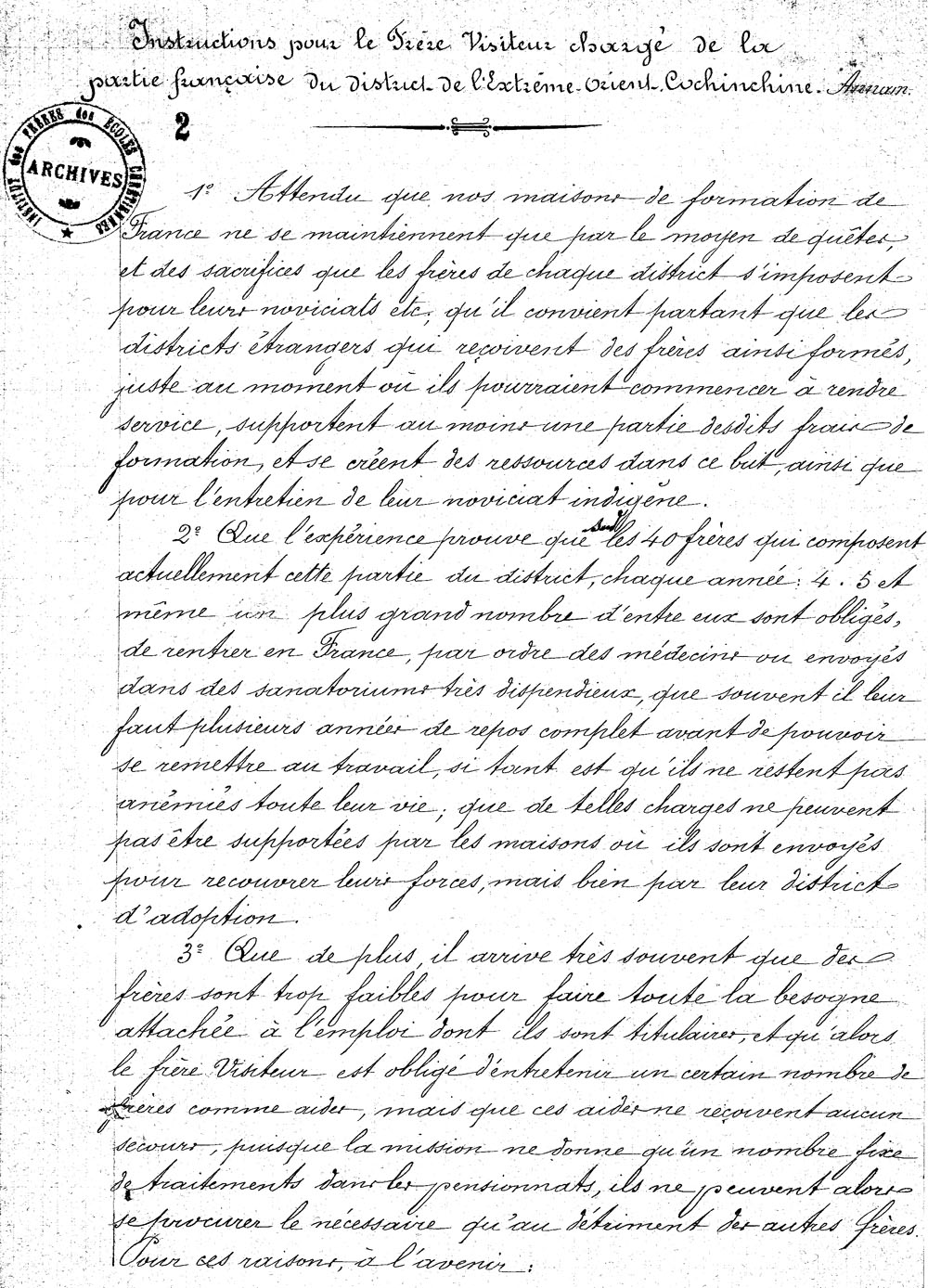
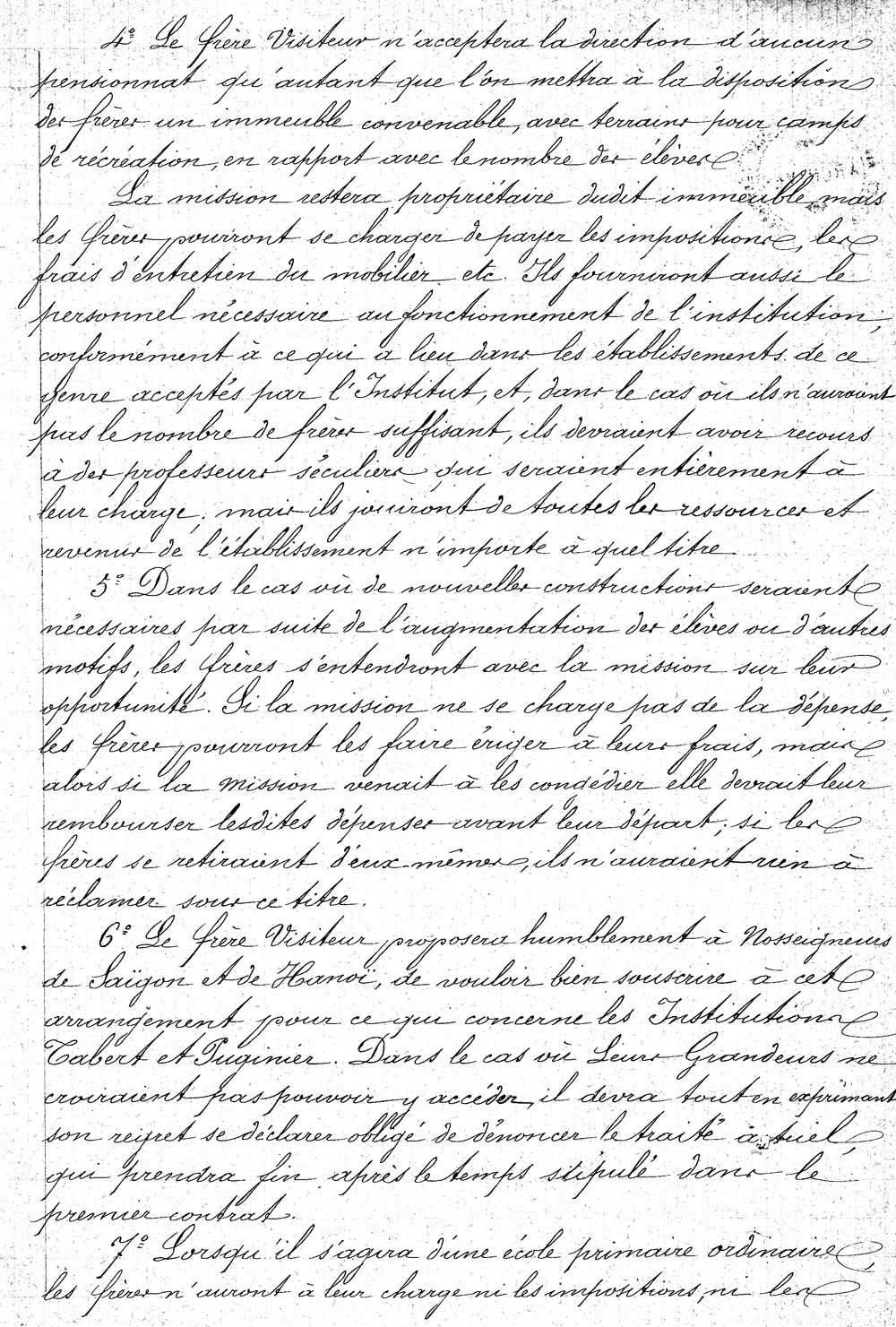
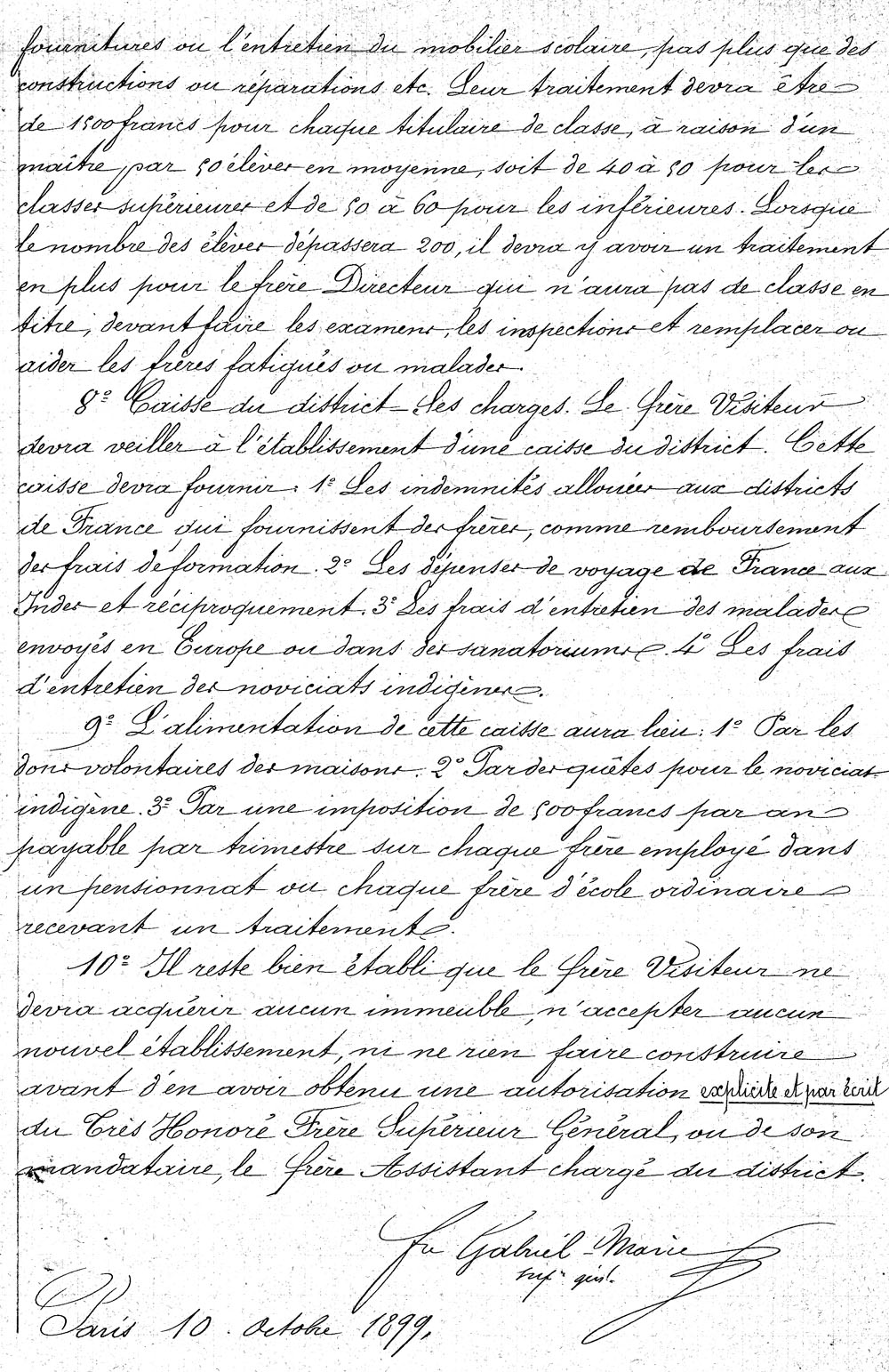
On October 10, 1899, Brother Superior General Gabriel Marie
wrote, hand writing, a letter to Brother Visitor in charge for the Indochina
Region. He reminds him of taking care about certain points, like:
- "... some Brothers should go back to France for health purpose:
medicaments, etc..."
- "... some Brothers who are so fragile or ill that they cannot
accomplish their assigned duties..."
- "... Brother Visitor should accept running a boarding class only
when some required facilities are met, and it should be a courtyard for
recreation large enough corresponding to the number of students, etc..."
- "..."
***
C. Documents D1f2 #4
Extracted from the report of the Missions to the Sacred Congregation for the Missions on October 1, 1903
"... The Mission has been established in
1844, composing of six cities Indochina, Cambodia and a part of Laos.
... the number of converted to Catholicism: 63,493 over the populations
within the Mission region: 2,968,529 (as of December 27, 1901)
... the persecutions of Catholic people reversed and destroyed everything:
no more churches, no more convents, no more schools...
... The body for the services of Religion: 54 French missionaries, 74
indigene priests, 50 senior seminaries, 72 junior seminaries, 50 catechists.
... The body of Religious: 46 Brothers of the Christian Schools and 26
Novices, 33 women Carmelites (included 30 indigenes), 90 French and 190
Indigenes of the Saint Paul de Sartre, and 400 indigene women religious called
"Lovers of the Cross."
..."
Resources funding for the recruitment of new vocations from local young people are not abundant, but recruitment of new disciples totally committed to the education mission, following the steps of Saint De La Salle and Older Brothers on such mission is always fundamental for continuing the ideal of serving young people, especially poor children. Saint De La Salle was convinced that "the education of workers' children... is always necessary anywhere any times."
In addition, in the countries particularly in Asia where the concept of "new religion that they call evil " - specifically from European armies who have been for a long times considered as "colonialists abusing of the religion to invading and steeling lands and goods from indigenes", people who collaborated with or converting to Catholicism are more or less persecuted, put in jail or killed, or at least considered by relatives and friends and neighbors as traitors. However, there are some people who followed the "evil religion" not without their own idea to benefitting of any materially or psychologically personal interests they could inherit from such new religion. "Once they cannot inherit certain interests the thought, they return to their traditional religion. And the missionaries know it, because they confess that indigene people could only be converted to Catholicism on their second or third generations..."

It is not un-understandable since in Asia in general and in a country like Vietnam in particular, traditional cultures and religions (as Confucianism, Buddhism, etc... or simply the Cult of the Sky or Ancestors) have been acculturated into Asian People Life and Thinking, for a long, long times ago - more than four thousand years before. Accepting or Following a "new religion" is out of mind. It's not to say that such a "new religion" is nothing else but a pretended reason for invading AND colonization of "poor and barbarian" peoples. In fact, as of proof of such intention, one can find a note about bishop Pellerin meeting with King Napoleon III and asking him for intervention by force to so-called liberating persecuted persons who follow the "new Christian doctrine" and stopping "hate crime" against the indigenes who are or will be converted into Catholicism.
Document #261, December 1, 1892:
... In these regions, persecution against Christians not ceasing at all, but dramatically increased to a level of atrocity and cruelty one cannot imagine. Local authorities seem to solicit persecution by "opening an eye, closing an other". Even some members of the royal family of king Minh Mang, who had been baptized, were executed or exiled or jailed..."
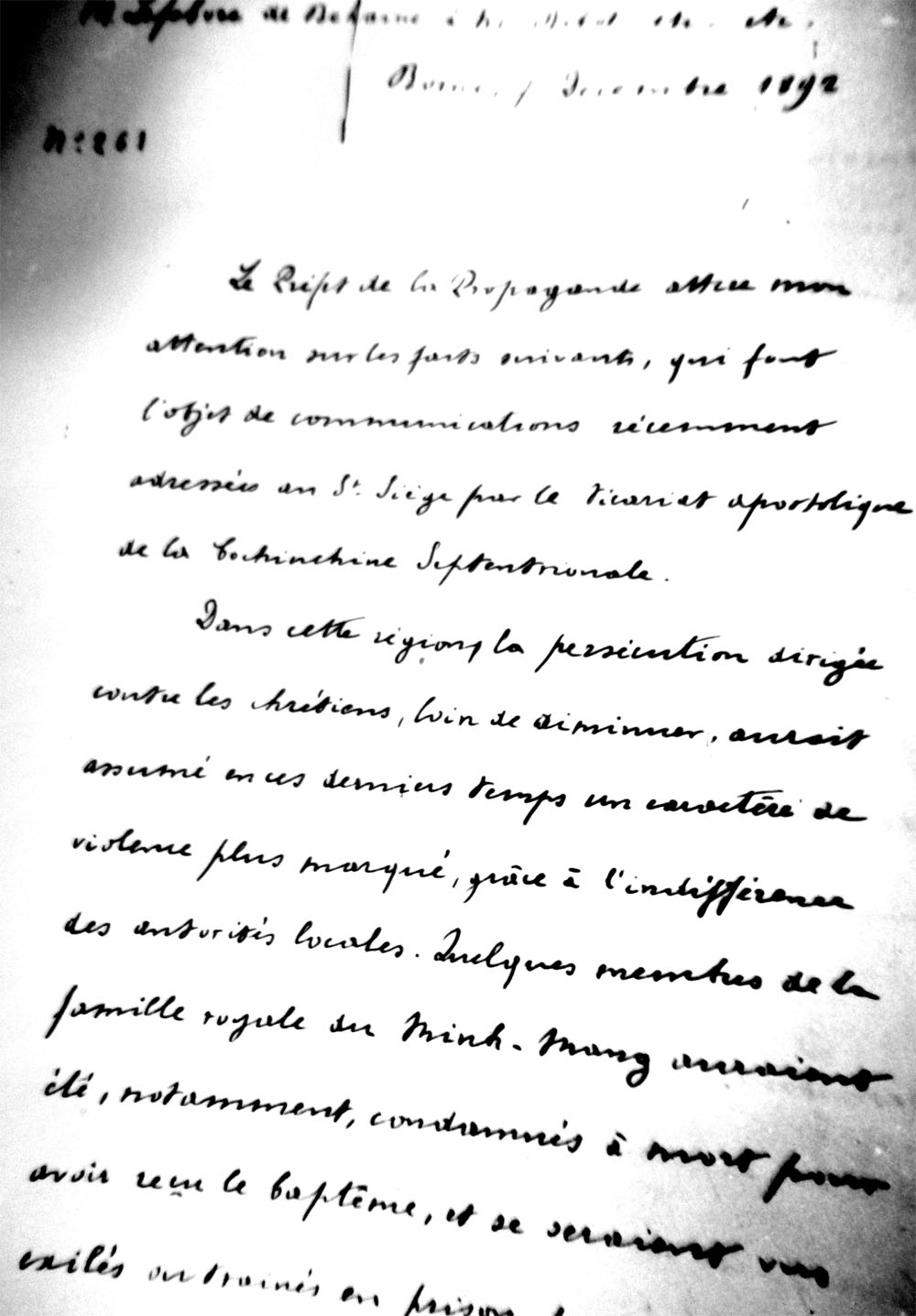
Although such a cruel and violent persecution against the propagation of the Catholicism which is considered "an evil religion imported from the West" is still very alarming, there are no less people converted to Christianity, and no less young people who just received baptism, immediately requested to join the religious life despite of any obstacle - even chased and imprisoned by their own family members.
Document NJ 450 D8f2 4/14 :
"... If a boy (a student) is converted to Catholicism, it's really a
disaster leading to a turbulent chaos in his family: it's a total abandon of
the past tradition, a total destroying all of the dreams and hope of the
Ancestors and Grandparents and Parents and Relatives for a most holy
Tradition of the family...
But, the Providence has His own ways, and decides
contrarily to what one could understand.
This young boy with a handsome and sweet face and two clever eyes under the
eyes-glass revealing something like "smart before age", will be a precious
tool the Providence has in His hands to convert his brothers and sisters and
the whole family, even the whole village, to Catholicism. That boy will be a
zealous disciple of Jesus-Christ preparing fertile soil for the Good News.
In fact, this boy is baptized on December 1912, and despite of any kind of
menaces - even many times "kidnapped" by his family and miraculously escapes
from these obstacles, receives the Religious Habit with the new name "Brother
Vincent Hoa" and enters the Novitiate in Hue on August, 1914. That is
one of the first "An-Nam" Lasallian Brothers in Vietnam."
The first Novitiate was open in Thuduc in 1895. From 1904 there is rumor that changes that have been made on education policy by closing all religious schools in France could also be applied to the colonies, particularly in Indochina and Vietnam. The Superior move the Novitiate from Thuduc to the Capital of Annam in Hue, on January 5, 1906.
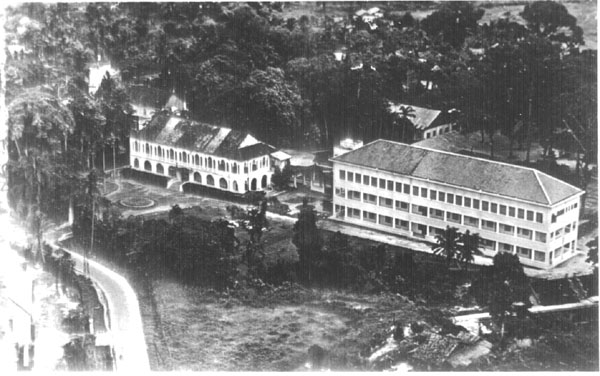
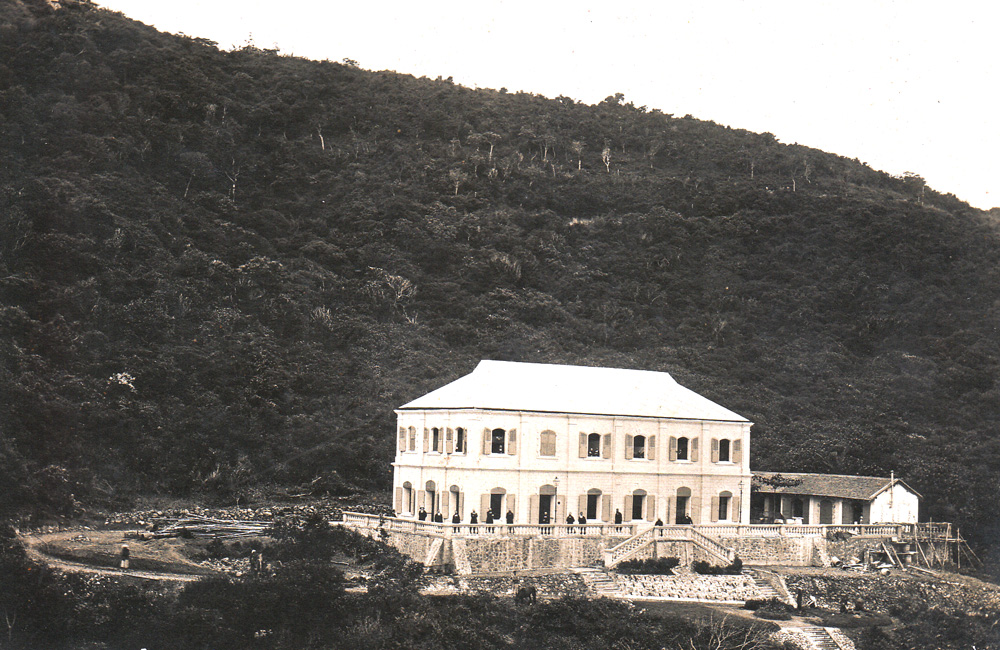
In 1933, the Formation Houses are moved to Nha Trang, on a mount at Cu-Lao about 25 meters from the sea level. Here, during more than 10 years long, Junior Novices, Novices and Scholastics have been working hard to transform the wild mount into large platform and so build a site really wonderful panorama of Mont De La Salle.
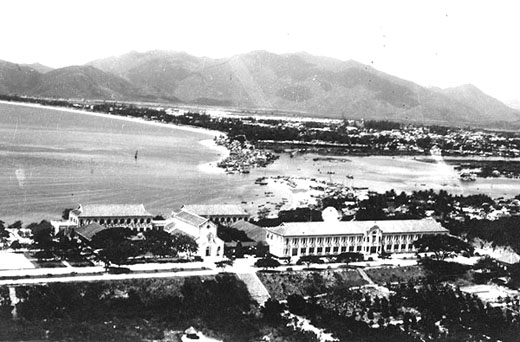
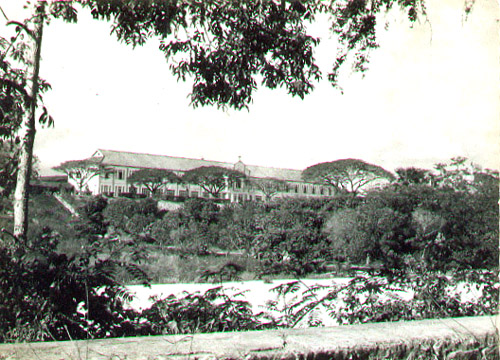
Mont De La Salle in 1945
***
D. Six Brothers of the Christian Schools disappeared on the high seas, in route to Hai Phong.
In 1924, there are 77 Brothers teaching and administering 8 establishments and 7 schools. But the need of education is too big. Six more Brothers are sent from France to help the education mission already established in Vietnam. They embark on October 23, 1924 from Marseille, and debark in Saigon on November 17.
Early morning the next day, they continue their trip:
- Brother Bernard-Joseph, destination Hai Phong;
- Brother Daniel-Laurent, destination Qui Nhon;
- Brother Cléophas-Louis and two young men accompanied by Brother
Domitien-Elie, destination Hue.
The ship arrives to Cap Saint Jacques when the weather forecast announces and alarms "a very strong typhon...", but the captain of the ship thinks no need to u-turn back, and rather to continue the trip.
...
The communication was lost...
During two weeks beginning December, many boats turn around the area for rescue. No sign of the ship.
Total despair on mid January of 1925.
There are Funeral Masses in different cities:
- On January 17, in Phnom-Penh;
- On January 19, in Hanoi;
- On January 19, in Hue.
...
RIP
- Brother Bernard-Joseph, cousin of Brother Visitor Louis, 58 years old;
- Brother Cléophas-Louis, 50 years old;
- Brother Domitien-Elie, 50 years old;
- Brother Venant-Marcel, 23 years old;
- Brother Constant-Emile, 19 years old ;
- Sư Huynh Bernard-Paul, 18 years old.
[Please read Appendix for more details]
***
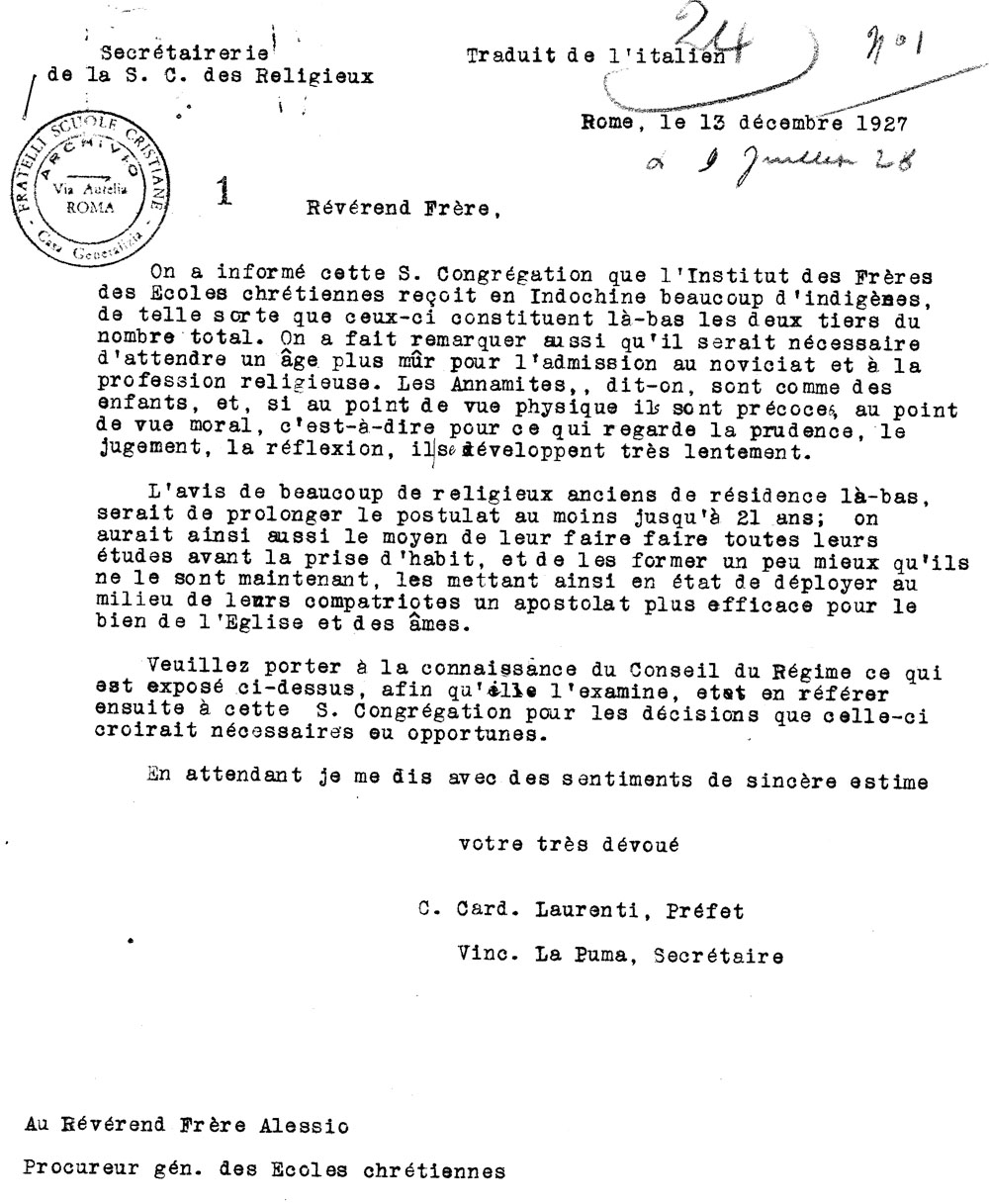
E. The recruitment for new vocations from young indigene people - perhaps "too young", has been reported to the Sacred Congregation of Religious in Vatican. The Secretary, Vincent La Puma, by order of Cardinal Laurenti, sent a letter to Brother Alessio, Postulator of the Brothers of the Christian Schools, on December 13, 1927:
Secretary Office
of the Sacred Congregation of Religious
Roma, December, 13, 1927
Reverend Brother,
It was reported to the Sacred Congregation that the Institute of the Brothers of the Christian Schools recruited in Indochina so many indigenes that they constitute two thirds of the total number of Brothers. It also remarked that it would be necessary to wait for a more matured age to be admitted to the novitiate and to the religious profession. The "Annamites," it was said, are like younger children, and on the point of view physique, they are of immature precocity, and on the view of point moral, i.e. for what concerns about prudence, judgment, reflection, they develop very slowly...
Advice from those who have been living over there for a ling times is that it would be good to prolong times of Postulant until 21 years old; it would then give them more times to study before the taking the religious habit, and so to form them a little better than they are actually, and then they could be sent working amidst their compatriots, more effectively for the good of the Church and for the souls.
..."
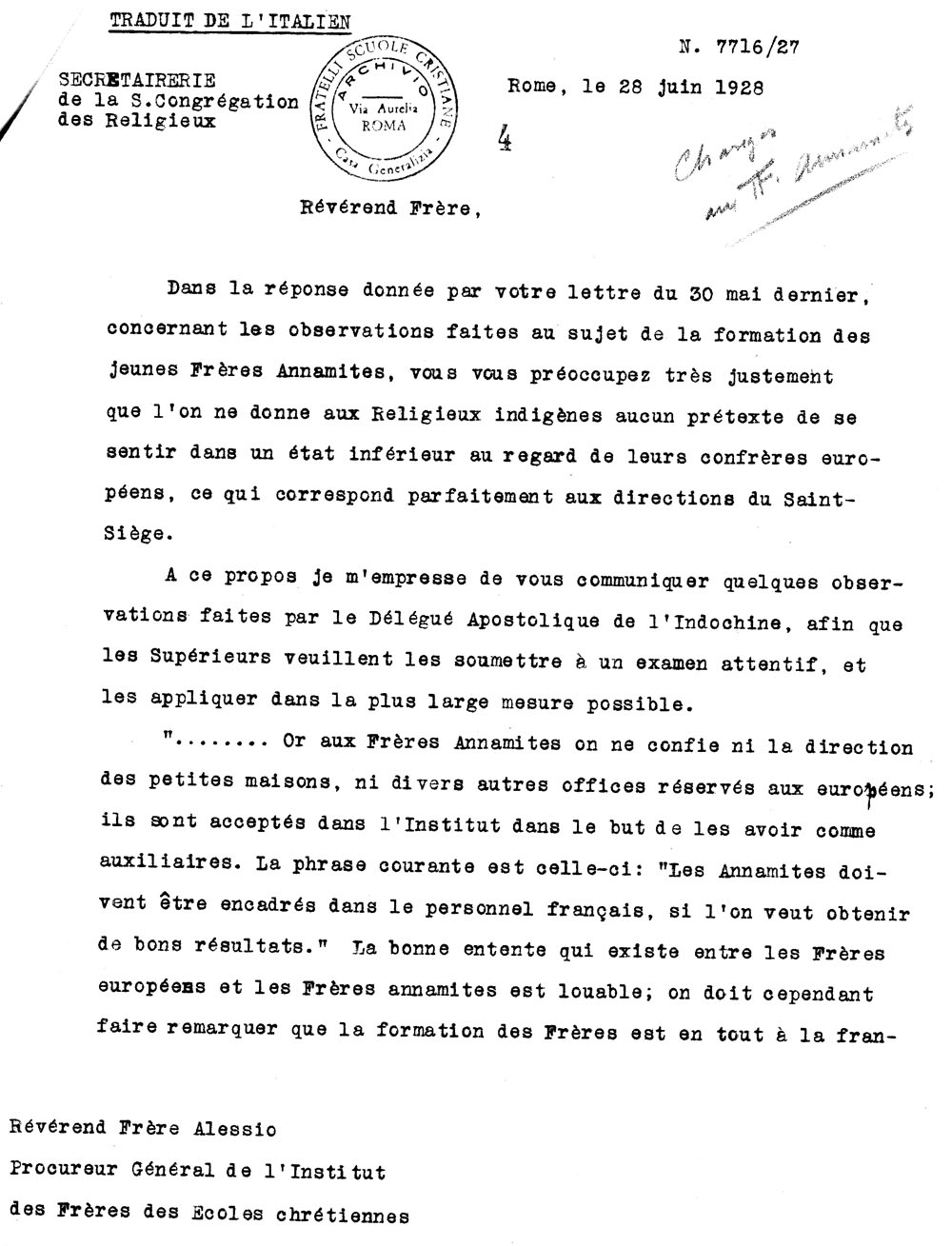
Brother Alession, Postulator, replied to this letter on May 30, 1928, emphasizing that "... the leaders of the Institute do not want to cause a prejudice for the indigene Brothers to feel inferior with their co-disciples from Europe..."
On this point, the Sacred Congregation of Religious replies
on June 28, 1928 "... This point is totally conformed to the directions
of Vatican..." and emphasizes:
"... On this matter, I empress to communicate to you some observations
from the Apostolic Delegate of Indochina, so that your Superiors examine and
apply into many different fields as possible.
... The indigene Brothers of An-Nam are not assigned to administer little
houses, even different offices exclusively confided to European Brothers.
These indigene Brothers have been admitted to the Institute for the sole
goal to have them as auxiliaries...
...
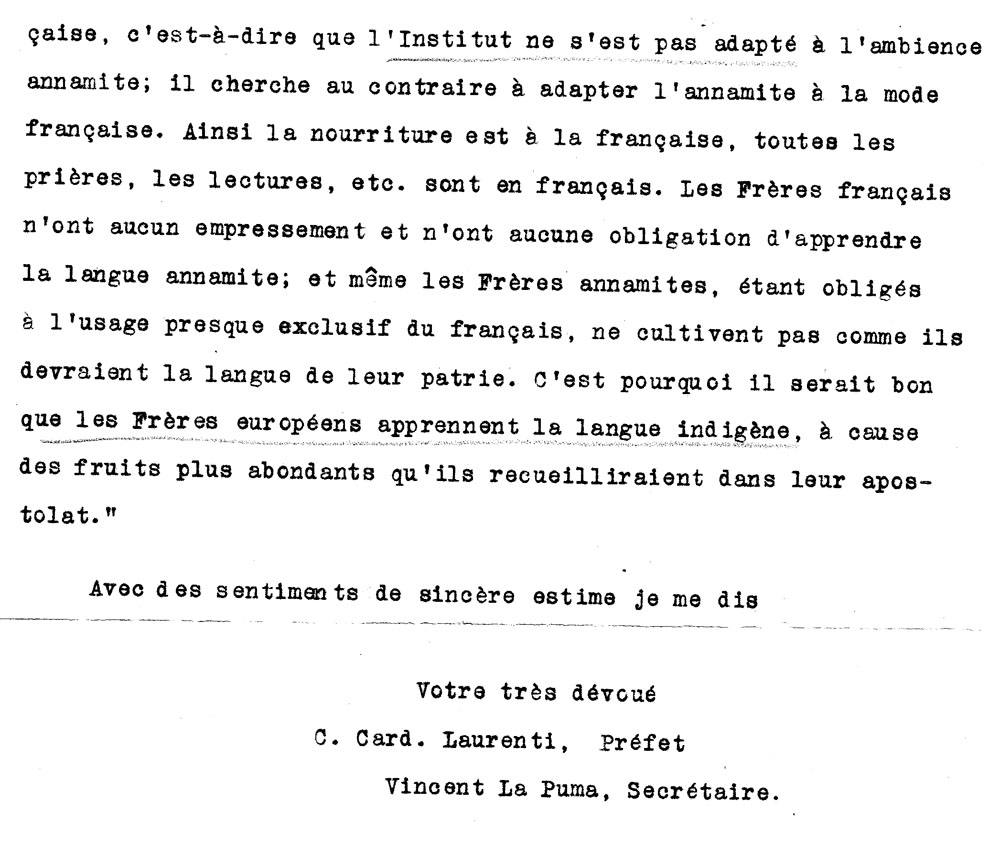
... The relationship among European and Indigene Brothers is laudable.
However, it is necessary to pay attention to the formation of the indigene
Brothers. It seems that their formation is totally based on the life-style
of European, i.e. the European Brothers are not to adapt to the local
life-style and culture, contrarily, the indigene Brothers are obliged to
adapt to the life-style of European Brothers. Thus, meals are à la
Francaise, all sort of prayers, readings, etc. are in French...
... The European Brothers show no eager of and do not oblige themselves
to learning the indigene language; and the indigene Brothers are obliged to
studying and quasi-totally to speaking only French. They are not permitted
to learn their own native language and culture as they should...
... That's why, it is much better that the European Brothers learn the
indigene language, for the effect of such learning brings more abundant
fruits from their apostolate."
***
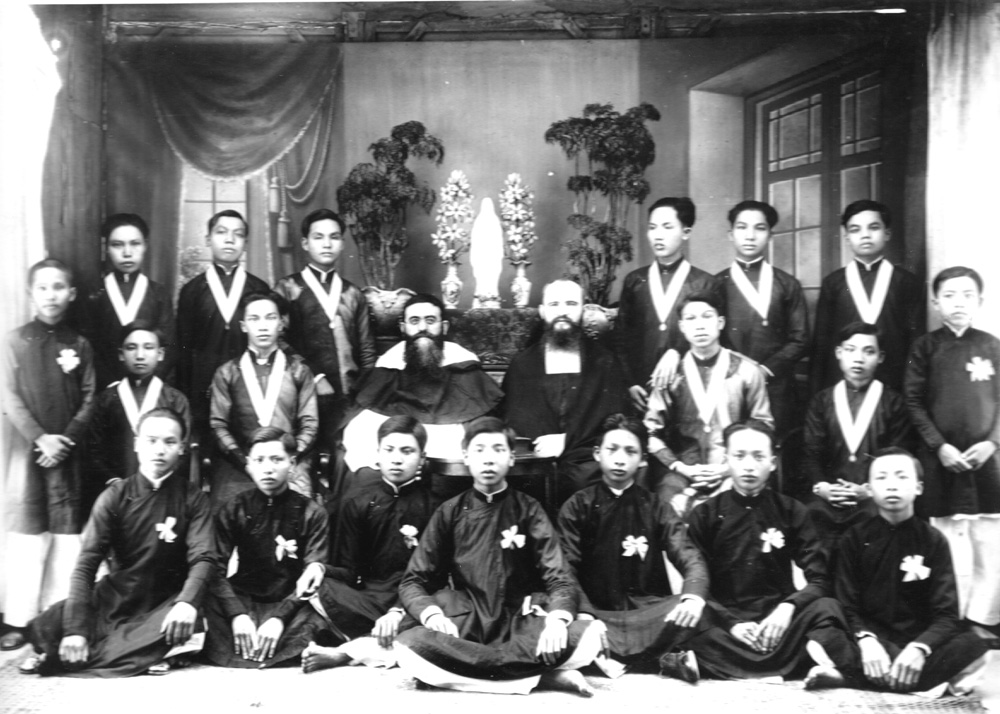
Some photos of the Junior-Novices, Novices and Scholastics in 1890-1954
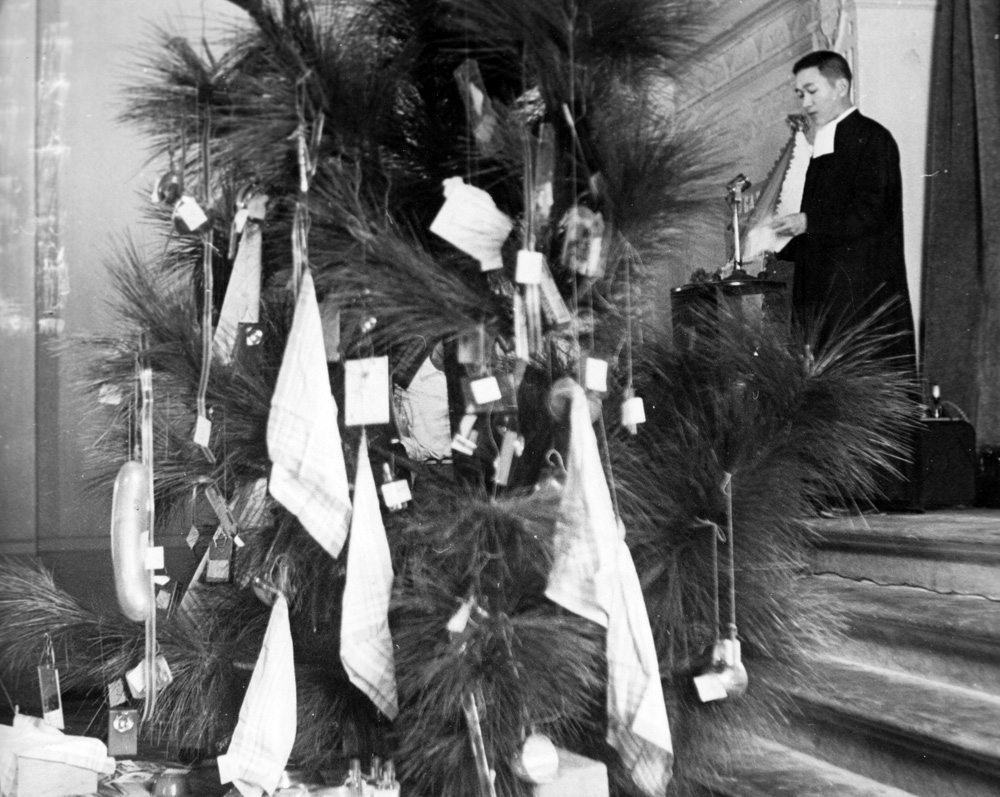 Christmas Tree, 1900 |
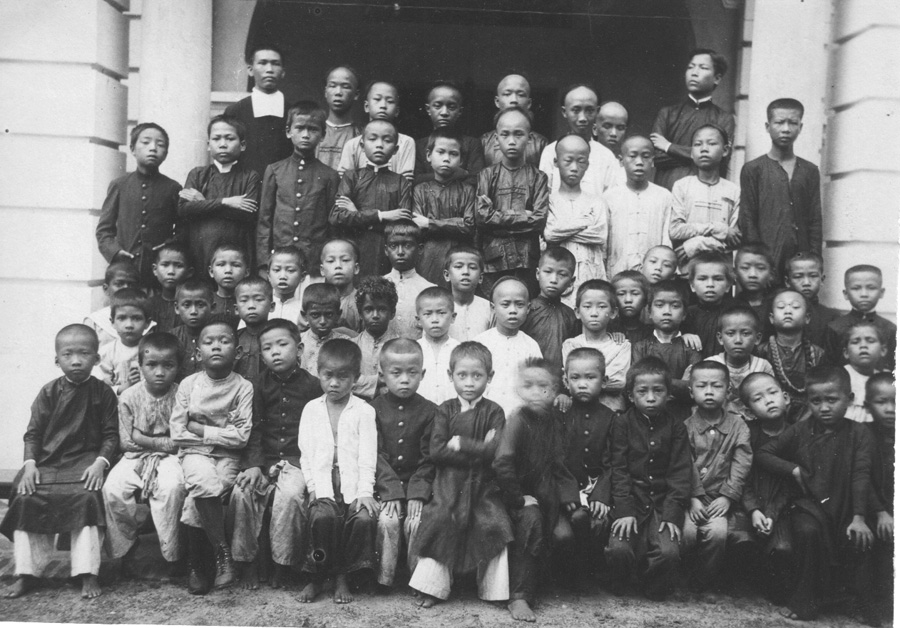 Junior-Novices in Hue, 1910 |
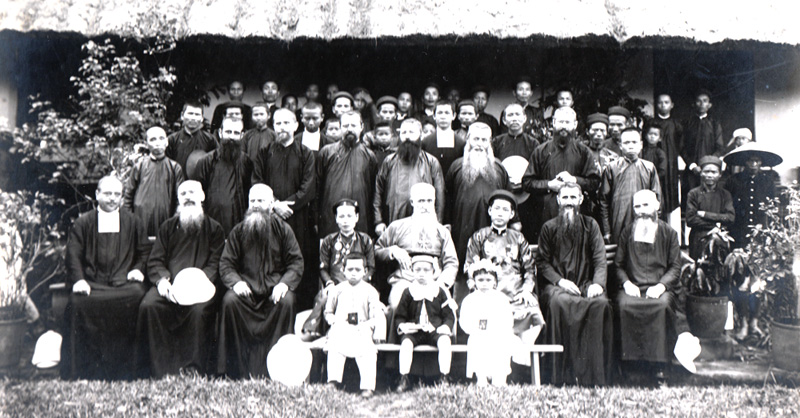 First Communion (son of Mr. Ngo Dinh Kha) |
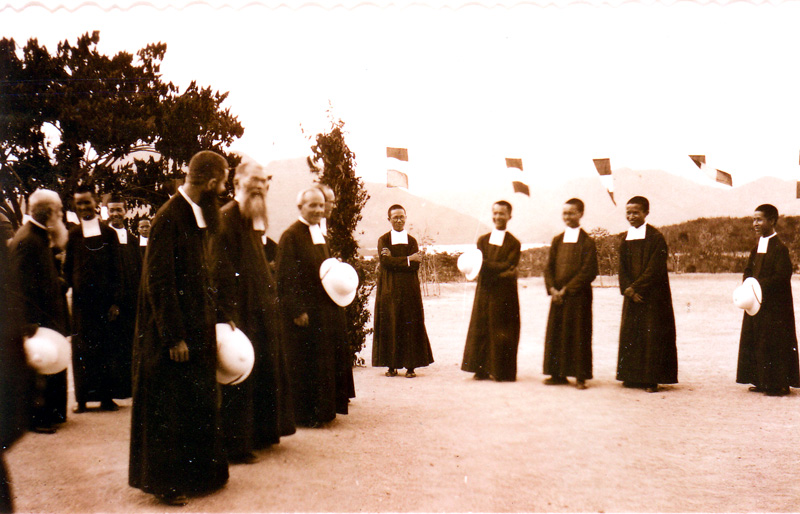 Group of Novices in Hue, 1930 |
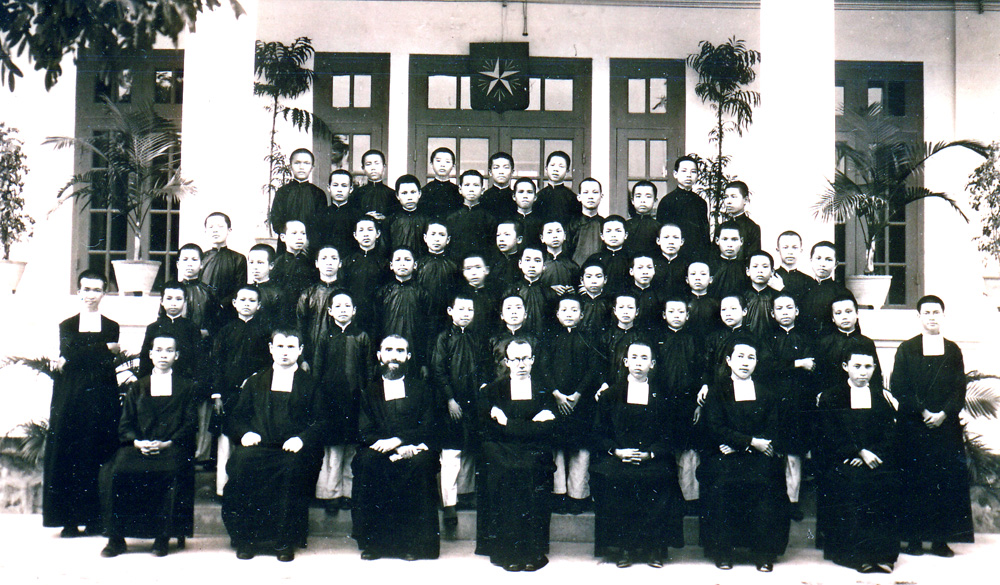 A Group of Junior-Novices in Nha Trang, 1937 |
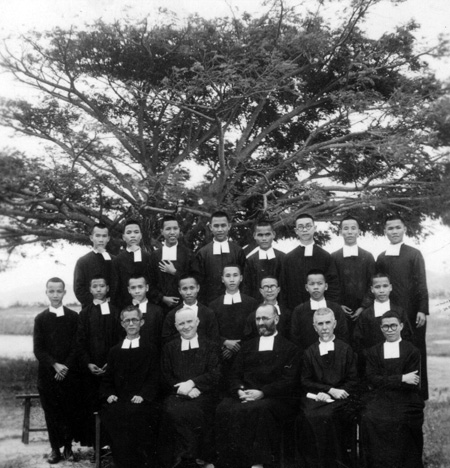 Group of Novices in 1947 |
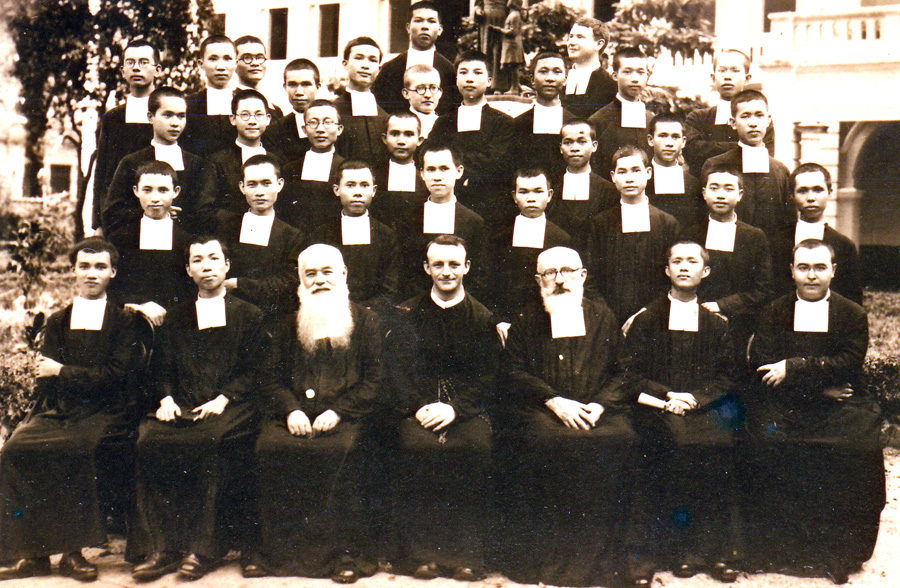 A Group of Scholastics and Brothers, 20 Day-Retreat in Saigon, 1934 |
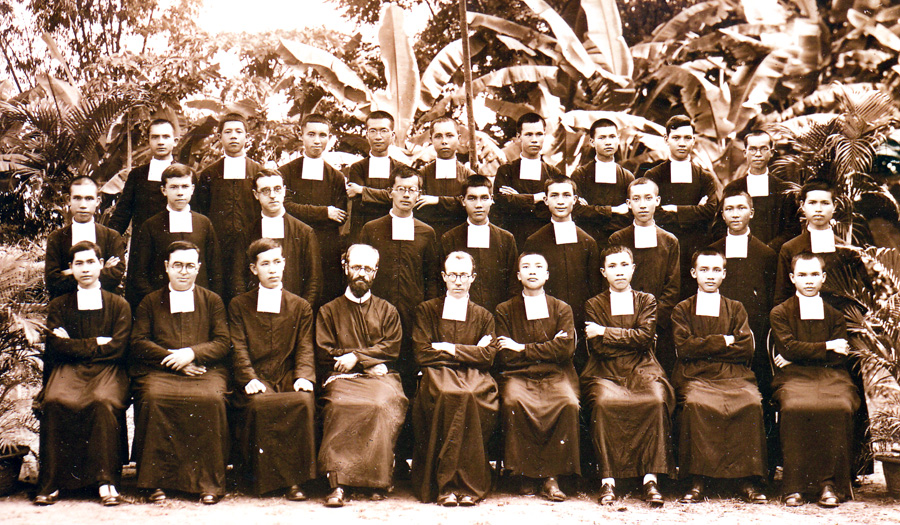 A Group of Scholastics and Brothers, 25-Day Retreat in Hue, 1938 |
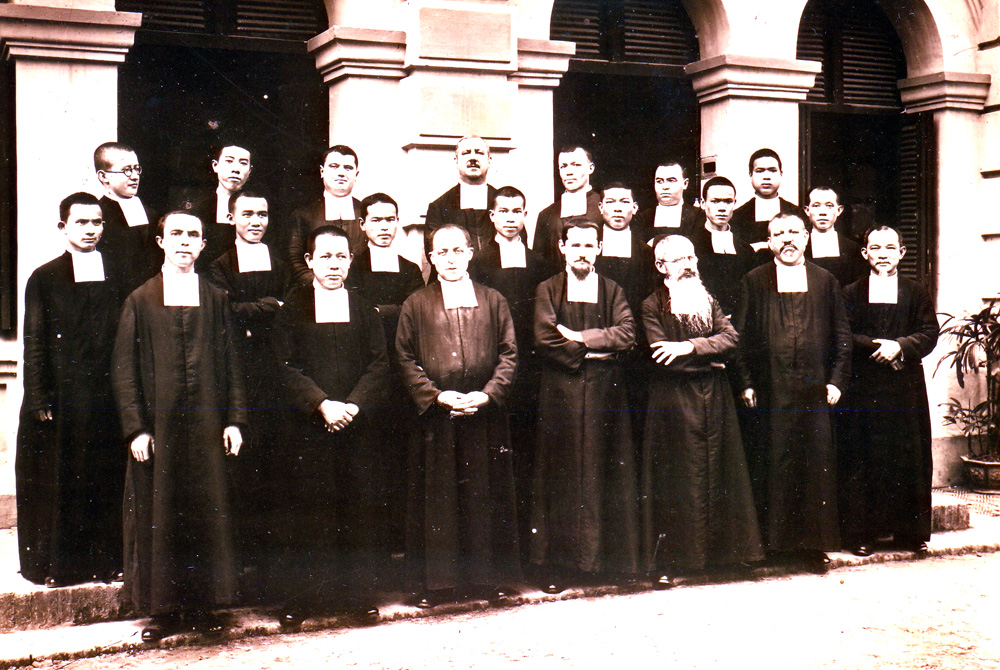 Brothers Community at Puginier, 1936 |
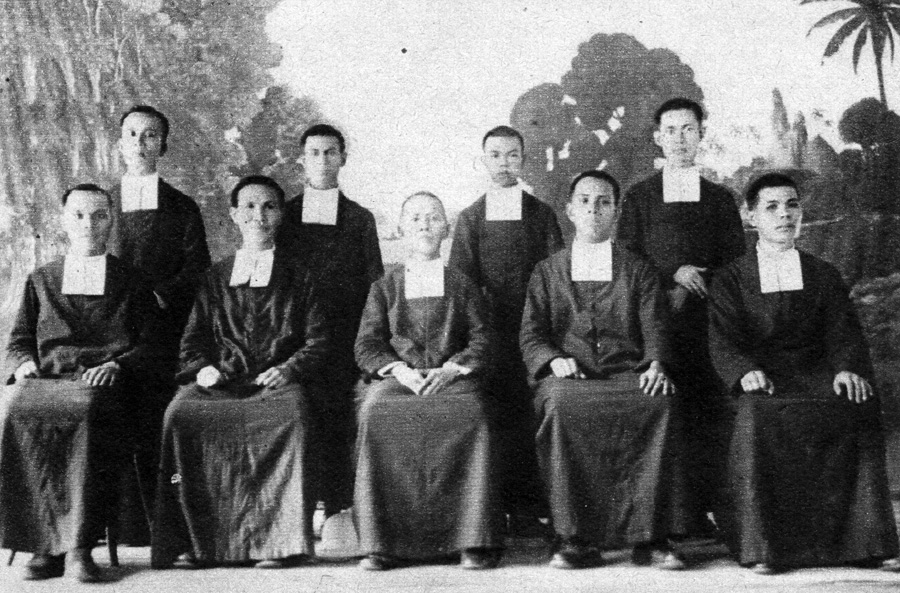 Brothers Community in My Tho, 1933 |
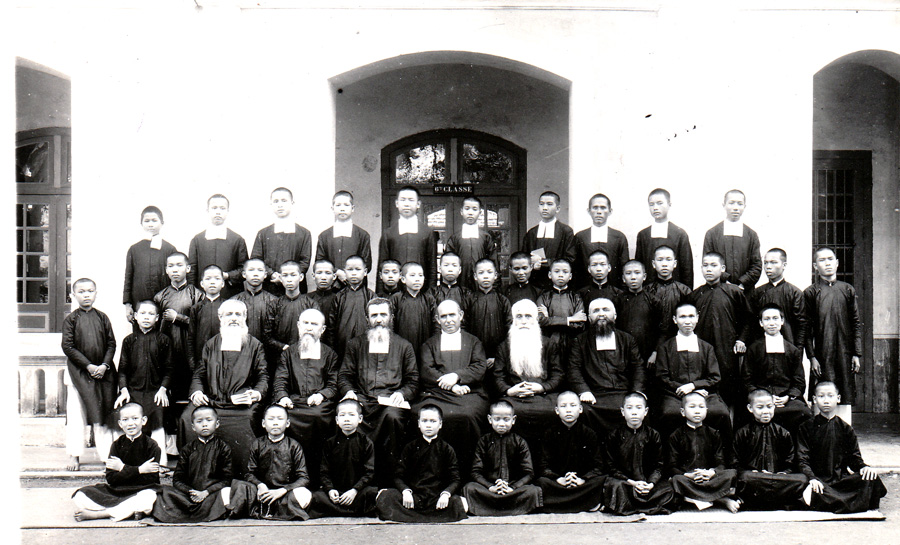
 Group of Novices at Pellerin, 1927 |
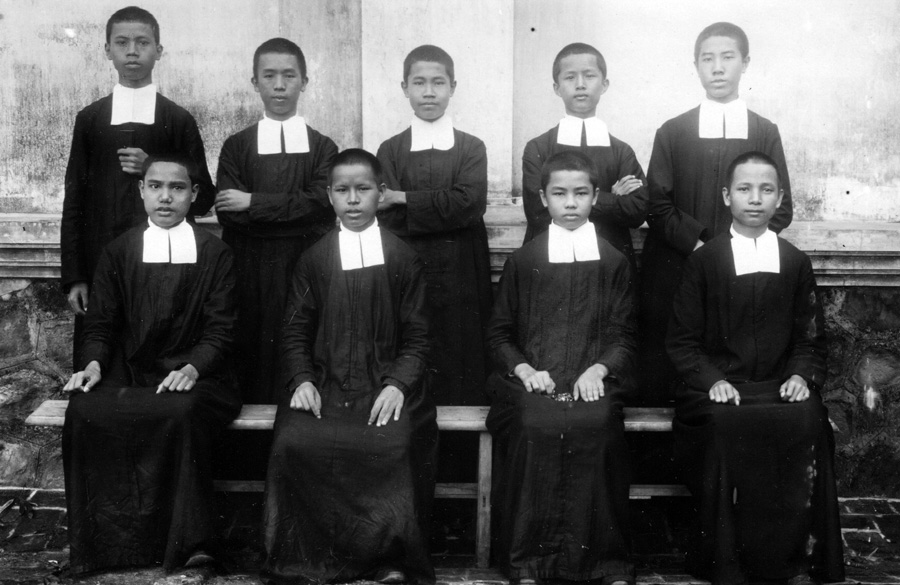
 Group of Junior-Novices at Pellerin, 1924 |
***
F. Establishments and Schools from 1890 to 1954
| Name of School | Location | Open Day | Close | First Brother Director |
| Institution Taberd School of Puginier Collège of the Mission Novitiate of Saint Joseph School Saint Jean-Baptiste Boarding School of Saint Louis School for Mute and Deaf Saint Michel School Pellerin (Bình Linh) (*) School for Mute and Deaf School at Battambang Novitiate School Saint Joseph School Saint Joseph Villa Saint Louis School of Miche (**) School Saint Pierre School St. Fr-Xavier (Khánh Hưng) Junior-Novitiate School Gagelin School St. Louis de Gonzague (Đức Minh) School St. Thomas d'Aquin House of the Mission Mont La
Salle School Sainte Famille School Mossard School Notre Dame School Sacred Heart (Adran) School Cù Lao Vĩnh Phước School Nghĩa Thục School Chotiravi Paknampho (***) School Bá Ninh |
Saigon Hà Nội Hà Nội Thủ Đức Thủ Đức Cap Saint Jacques Tân Định Huế Gia Định Siam/Cambodge Huế Hải Phòng Mỹ Tho Vũng Tàu Pnompenh Pnompenh Sóc Trăng Huế Bình Định Tân Định Nam Định Phát Diệm
Nha Trang Bùi Chu Thủ Đức Nam Định Đà Lạt Nha Trang Hải Phòng Thailande Nha Trang |
01-01-1890 01-04-1895 15-03-1895 17-12-1895 01-08-1898 06-03-1899 01-01-1902 15-05-1904 01-07-1904 13-08-1906 05-01-1906 15-11-1906 01-04-1908 01-05-1910 01-03-1911 01-04-1911 21-02-1913 01-11-1915 03-10-1921 07-09-1923 13-01-1924 28-08-1932 22-03-1933 01-09-1939 15-10-1939 31-08-1941 01-10-1941 07-09-1952 17-09-1952 17-05-1953 01-09-1954 |
1975 1954 1954 1905 1907 1904 1904 1975 1908 1910 1933 1954 1975 1943 1970 1970 1975 1933 1946 1975 1941 1947 1975 1949 1975 1945 1975 1975 1954
1975 |
Frère Ivach-Louis Frère Basilisse-Marie Frère Oreste-Martin Frère Basilisse-Marie Frère Aglibert-Marie Frère Térentien-Léon Frère Salomé-Victor Frère Aglibert-Marie Frère Salomé-Victor Frère Dominique-Joseph Frère Idinael-Emile Frère Arnould-Robert Frère Crescence-Marie
Frère Christophe_léon Frère Colomban-Vital Frère Duvian-Albert Frère Ivach-Louis Frère Dunstan-Albert Frère Ildéphonse Lộc Frère Donatien-Régis Frère Téclan-Marcel
Frère Hoan-Marie Lê Thương Toàn Frère Divy-Joseph Frère Dominique-Joseph Frère Dosas-Emilien Frère Harman Minh Hoàng Anh Tuấn Frère Thomas-Hyacinthe Lương Bá Thông Frère Ariald-Prosper Frère Henry Hoà Nguyễn Ngọc Trân |
(*) Documents NJ 450 D8f2 11/14
"Bishop Biblos Pellerin Francois-Marie's
real name is Henri Agathon.
... In 1856, while King Tu Duc had been preparing more
strongly the war against the colonial French armies, Pellerin was pushed to a
more threatening menace for his life. He immediately disguised as a soldier then
masked as a sail man, and informed the captain of the battleship, Capricieuse,
still anchored at the port of Tourane, Danang.
... The war status in INdochina became more and more serious, the bishop
embarked on a ship and returned to France.
... In 1858, bishop Pellerin had a meeting with king Napoleon III, present at
that times in Biarritz. He reported to the king how the danger of war could
affect and threaten the missionaries' lives in An-Nam, and requested that king
Napoleon III act, immediately, so that freedom of religion can be safeguarded.
King Napoleon III promised to effectively intervened, and it was the main reason
beginning the attack and colonization of Indochina.
... A street in Saigon and a school in Hue bear this bishop's name: Pellerin."
(**)
"Bishop Danasara Miche's real name is Jean Claude.
... In 1842, bishop Miche and Duclos, a priest are arrested and tortured
at the same time, and released from prison in 1843 thanks to Colonel Favin's
intervention. Bishop comes to Indochina in 1844.
... In 1850, bishop Miche becomes Apostolic Delegate of the Holy See to Cambodia.
... In 1856, bishop Miche help successfully De Montingy fulfill his mission
confided to him by the French government in Siam (Thailand).
In 1862, bishop Miche also contributes to Amiral De la Grandière lots of
resources in writing the treaty which gains the protectorate of France over
Cambodia.
... Bishop Miche died in 1878, in Saigon, and was buried at the 'grave of Adran'..."
(***)
Extract from Brother Assistant Zacharias' s Journal (page 153-154):
"... Responding to the request of the Sacred
Congregation of Religious, five Brothers separated from Indochina come to
Thailand. The majority of Thai people are Buddhist (15 millions), and the
minority are Islamists. There are only about 30 thousand Catholics.
... Brother Ariald Joseph is the first to come to Paknampho. The Brothers of
Saint Gabriel who have been for many years before in Paknampho refused to open
schools being short of personnel. The school in Paknampho is formally open on
May 18, 1953.
...
A year later, on June 4, 1954, the Thai Prime Minister came to visit Paknampho,
gathering all staffs and faculties of the schools in the region. When the Prime
Minister saw amidst the crowd some Brothers of the Christian Schools, he came to
them, shaking every Brother's hands, talking to them first in Thai then in
French.
The Prime Minister gave to all schools 50,000 ticaux (Thai money). I cannot
specify how much our school, Rongine Tschotiravi, received from that grant.
Rongine Tchotiravi means The Shinning Sun, and local people suggest us
to change the name of the school Paknampho into Rongine Tschotiravi
...
The first day of opening the school, there were 240 students, circling the pot
flag and chanted the Thai National Hymn. Their parents, some invited, many
others by curiosity, come to school, entered classrooms... just to see "the
pharangs" (Frenchmen) in uniform of black robe and white rabat!
... The school "Shinning Sun" develops quickly, and successfully: The statistics
of students by year are as follow:
- 1955: 550
- 1956: 770
- 1957: 900
...
Documents 17450 - D8 f2 (#8 and #9)
| School | 1931 | 1932 | 1933 | 1934 | 1935 |
| Pnom-Penh * Brothers * Lay Teachers * Waiters * Students |
7 5 6 415 |
7 5 4 446 |
7 4 4 321 |
7 4 2 276 |
7 8 2 303 |
| Saigon * Brothers * Teachers * Waiters * Boarding students * Haft-boarding students * Students |
37 17 54 440 115 1204 |
37 15 54 425 109 1177 |
36 10 42 305 50 1026 |
36 11 42 176 60 851 |
34 10 42 172 52 857 |
| Sóc Trăng * Brothers * Teachers * Waiters * Boarding Students * Half-boarding Students * Students |
10 3 14 165 299 |
9 4 14 123 265 |
8 2 14 84 5 235 |
8 10 60 211 |
10 10 58 1 211 |
| Qui Nhơn * Brothers * Teachers * Waiters * Boarding Students * Half-boarding students * Students * Junior Novices |
4 4 10 54 2 246 9 |
4 2 10 56 4 205 |
4 3 7 52 4 180 |
4 3 7 57 200 |
|
| Phát Diệm * Brothers * Teachers * Waiters * Students |
3 9 1 470 |
3 10 1 514 |
3 9 1 580 |
3 6 1 380 |
|
| Hải Phòng * Brothers * Teachers * Waiters * Boarding Students * Half-boarding students * Students |
7 1 10 16 2 159 |
6 1 8 18 2 156 |
6 1 6 8 1 149 |
7 3 6 10 145 |
7 3 5 7 3 165 |
| Hà Nội * Brothers * Teachers * Waiters * Boarding Students * Half-boarding students * Students |
22 5 16 84 12 720 |
22 5 18 65 8 585 |
20 1 18 60 12 559 |
24 5 65 15 540 |
26 2 15 57 12 604 |
| Huế * Brothers * Teachers * Waiters * Boarding Students * Half-boarding students * Students * Junior-Novices |
18 8 32 214 18 438 |
18 6 10 162 9 341 |
18 3 40 92 10 355 |
17 3 28 73 10 272 |
17 2 28 79 14 261 16 |
| Nam Định * Brothers * Teachers * Waiters * Boarding Students * Half-boarding students * Students |
11 1 10 160 215 |
14 1 10 105 207 |
14 1 11 75 189 |
13 1 10 45 1 184 |
13 1 10 34 229 |
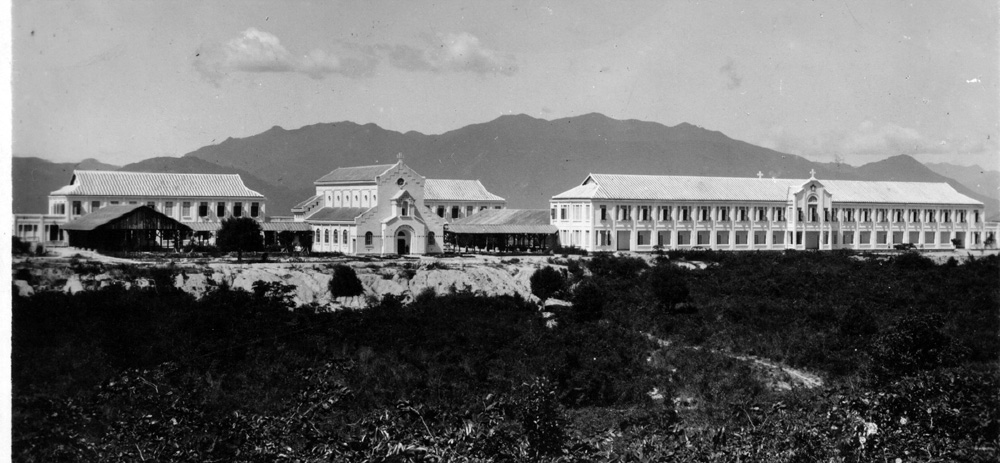
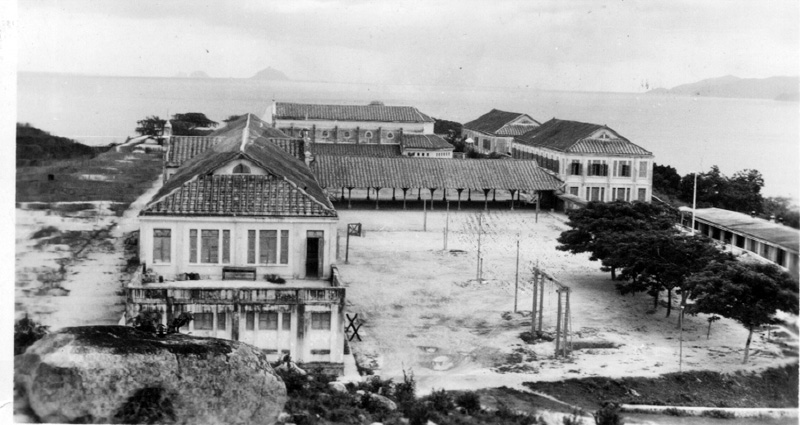 Mont La San, 1939 |
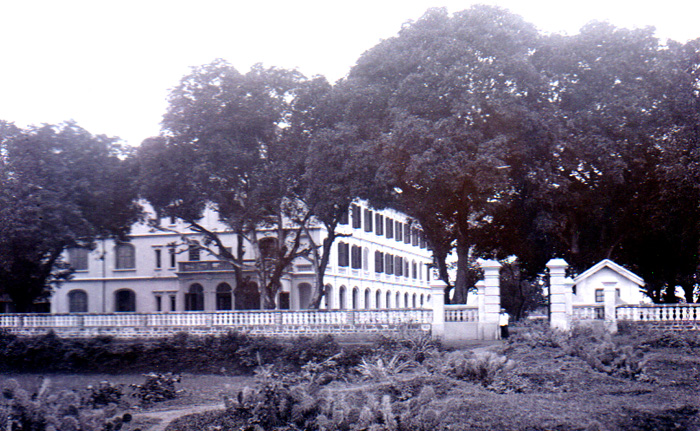
 Mont La San, 1954 |
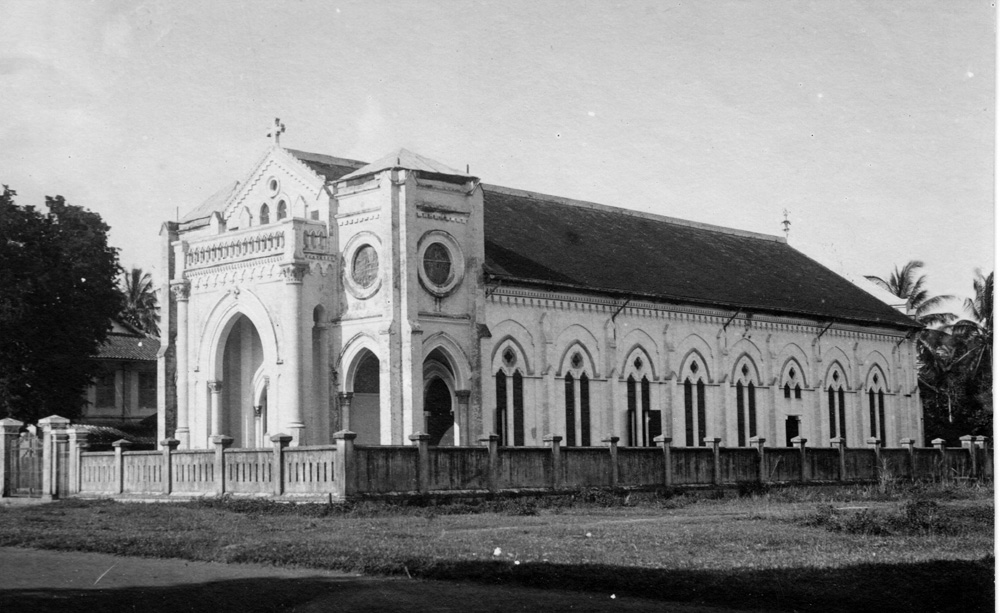
 School Gagelin |
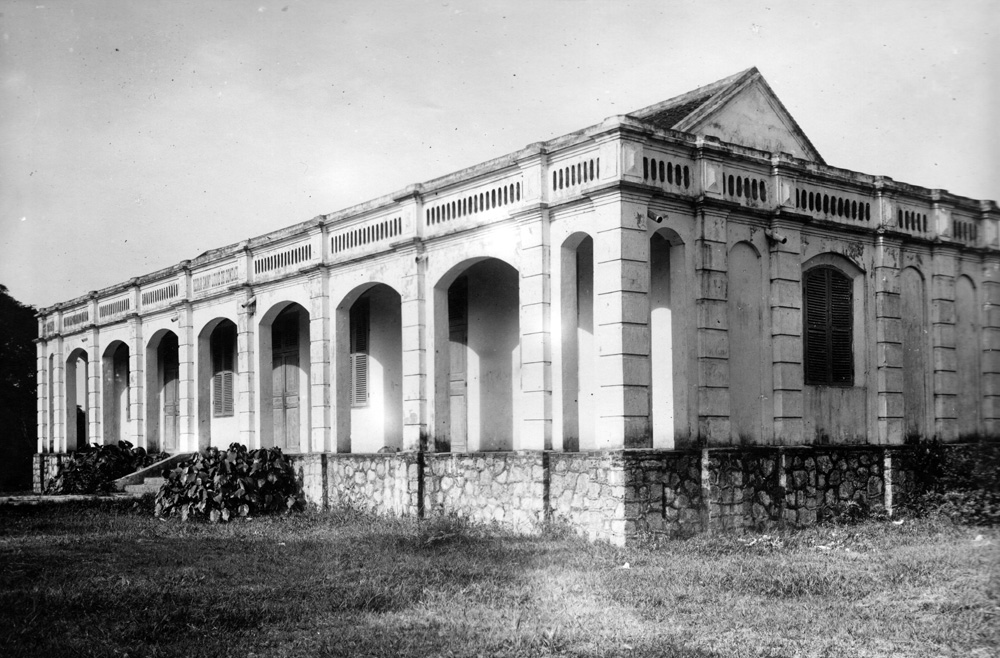
 School Mỹ Tho |
 School Phát Diệm |
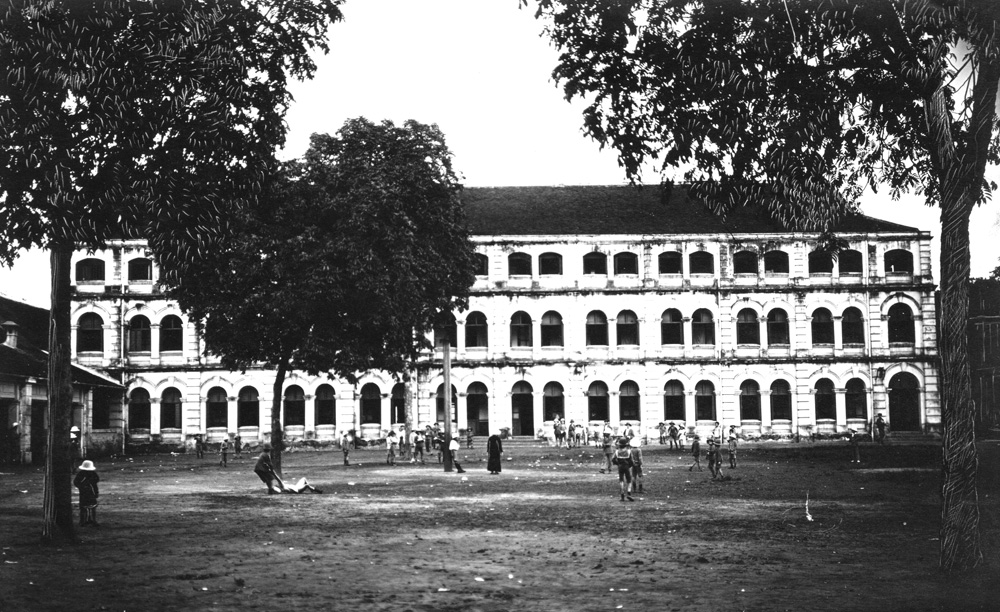 School Puginier |
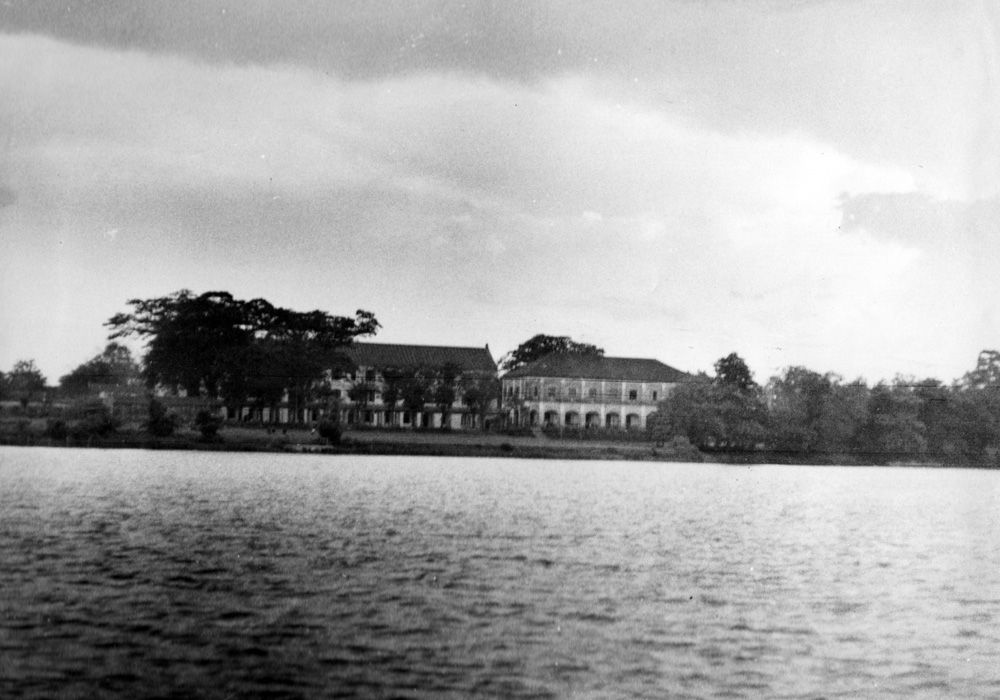 School Pellerin |
 School Sóc Trăng |
|
|
|
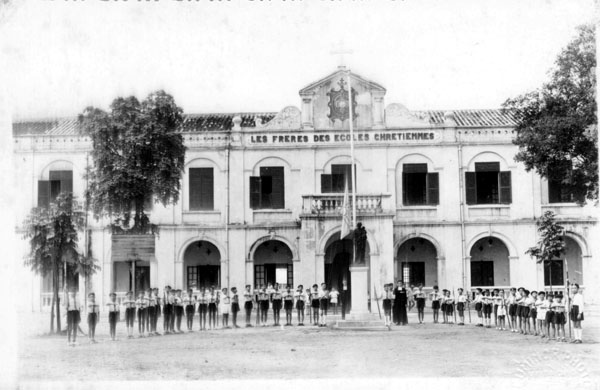 School Hải Phòng |
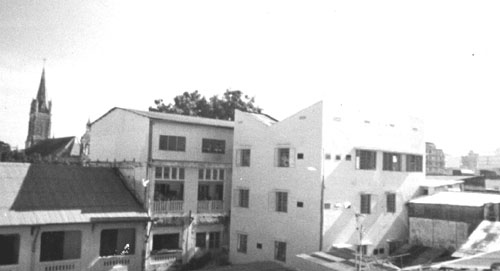 School St. Louis de Gonzague (Đức Minh) |
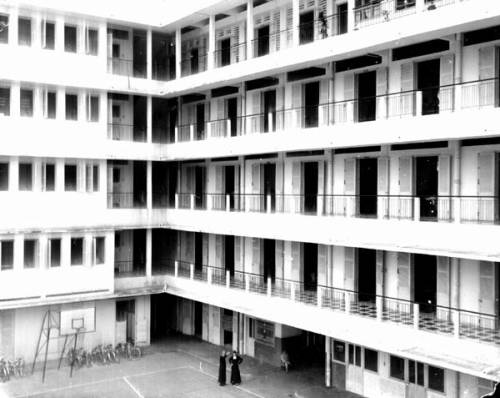 School Miche |
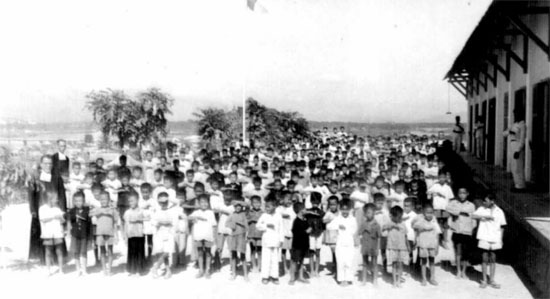 School Cù Lao (Nha Trang) |
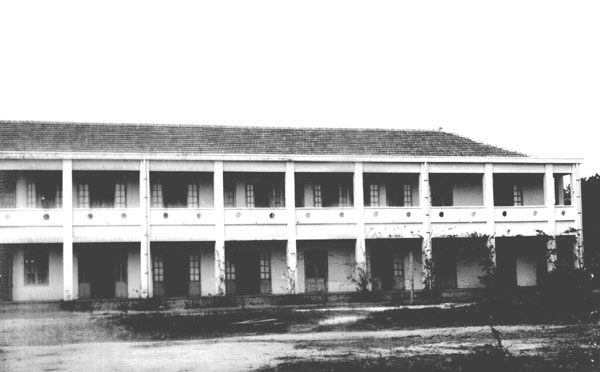 School Bá Ninh |
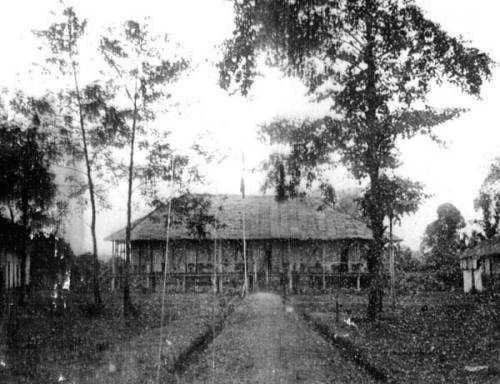 School Battambang |
 Boarding School (1899-1904) become Villa Saint Louis, 1910 (Vũng Tàu) |
 A Group of Students at Thomas d'Aquin, Nam Định |
***
G. From the 19th century to 20th century, the whole world has seen wars and wars: wars against colonization, wars ideology v/s ideology (NAZI against Democratic, Communism against Capitalism, etc...)
Vietnam was considered as a "barbarian and 'Moi (Highland)' tribal" country since the beginning of the 19th century. It has been occupied by French colonists until World War II, then by Japanese during WWII, and again by French colonists after WWII until their defeat at Dien Bien Phu in 1954. The accord of Geneva on July 20, 1954 divided Vietnam into two parts, at the 17th parallel: up to North under the communist party lead by Ho Chi Minh, down to South under the leadership of Ngo Dinh Diem.
When WWII is ended, Ho Chi Minh, leader of the communist party, proclaimed "Independence for the Democrat Republic of Vietnam" on September 2, 1945 - although on that times, French colonists returning to Indochina and Vietnam after WWII, still occupied South of Vietnam. The birth of the new country "Democrat Republic of Vietnam" is an important turning point not only for the History of Vietnam, but also opens a new "Front of Liberation" between two ideologies "Capitalism v/s Communism" on the very land of Vietnam. On North Vietnam, communist ideology lead by Soviet Union (and China); on South Vietnam, capitalist and democratic ideology lead by the USA and the so-called "free" countries.
Extract from Brother Assistant Zacharias's Journal (page 129
and 149):
"... On February 12, 1945, seventeen Brothers of the Christian
Schools were killed by Japanese armies in Manila, capital of the
Philippines...
... Until May, 1945, all of our schools are normally active. Suddenly,
incessant chases, persecutions, ... In Hue, two Brothers were
killed. In Nha Trang, Brother Visitor and four Brothers were arrested and
driven from village to village. The battleship Richelieu and
Triomphant come and liberate all of them..."
...
"... Brother Thomas Moore and Brother Celsus Edwin came to Vietnam in
1938. Both are British.
Japanese armies arrested and jailed some of the Brothers.
Brother Celsus Ewdwin was driven to a prison in My Tho and was jailed there
until the Japanese capitulated.
Brother Thomas Moore and his companions were killed by Japanese armies on
July 1, 1945.
Extract from Brother Assistant Zacharias's Report #2:
"... General View on the political situation in Northern
of Vietnam.
It's really difficult to have an idea about this matter because news
received from different resources are contradictory each other. From March
9, 1945, propaganda against French is clearly exciting, strongly
emphasizing the problem of "independence" as a unique order of the day,
besides it nothing's more important. And the effect of such a propaganda? -
a general and spread chaos never seen before, on all fields of social life
of people.
... Such a propaganda disoriented and put all conceptions of conscience into
erroneous ways of darkening and confusing thinking, thus created doubts,
hate and violence.
The local religious hierarchy seems to be the most affected. No more sense
of obedience to and respect of the superiors. For many people, politics
overwhelming part of life and forgetting or even abandoning the Good News...
Our schools used to run normally and developed well until the March 3, 1945
event. Actually it seems that they are "sleepy" (Hanoi), "on-off" (Phat
Diem, Trung Linh, Haiphong) or must be closed (Nam Dinh).
Keeping working a school at the capital of Vietnam (Puginier, Hanoi) might
be necessary. The staff and faculty must be all of Vietnamese origin..."
Brother Director of the Novitiate in Nhatrang noted:
"... Vietminh occupied Mont LaSalle... Old
Brothers, Novices and Junior Novices, etc... must be separated and
disbanded. Some returned to their native village... Some others in small
groups moved to Hue, Luong Son...
... When the Vietminh armies had left Mont LaSalle, I returned and could not
stop tears rolling down. A strong hurricane/typhoon might not destroy and
damage that much as the Vietminh did..."
Documents 0701/1801: Brother
Visitor Domicé wrote from Saigon on December 29, 1946:
"... Very serious events have happened in Tonkin and An-Nam from
December 19. The events occurred on September 1945, if compared with these
events, are just nothing but a slight beginning...
... The executioners of September 1945 begun their jobs and excellently
accomplished their missions by their own means: they killed people so
barbarically that the American Consul could not retain to shout out: "That
are acts of animal cruelty"...
***
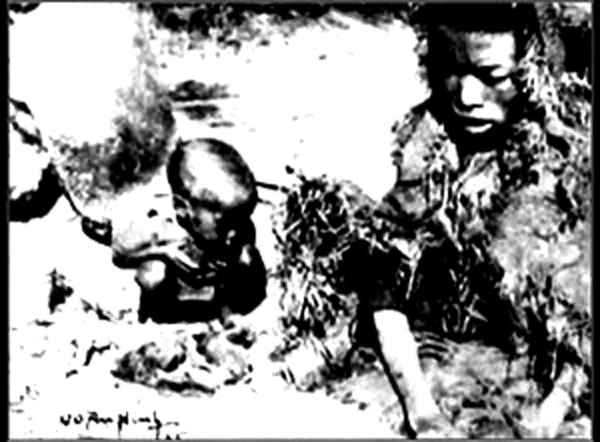
Unforgettable Event of 1945:
hunger.
More than 2 millions died of hunger... The whole family, the whole
generation, the whole village...
|
|
|
Documents 2409 #6:
"The General Counsel approves on December 16, 1946 the 'temporarily'
closing of some schools in Tonkin and An-Nam: Three (3) Brothers stayed in
Hanoi, taking cares of the schools and establishments in Ha Noi, Hai Phong,
Phat Diem.
All other communities temporarily closed: Ha Noi, Hai Phong, Phat Diem, Bui
Chu, Nam Dinh.
In An-Nam: Qui Nhon School closed."
Documents 2409 #13:
Brother Cyprien, Visitor, wrote from Saigon, on June 3, 1947: "... French
armies occupying the upstairs of Pellerin, fired onto the Vietminh's camps
on the other river side. That's the reason why the Vietminh fired back, and
damaged the establishments... The Vietminh accused the Brothers for having
allowed French armies to occupy the establishments..."
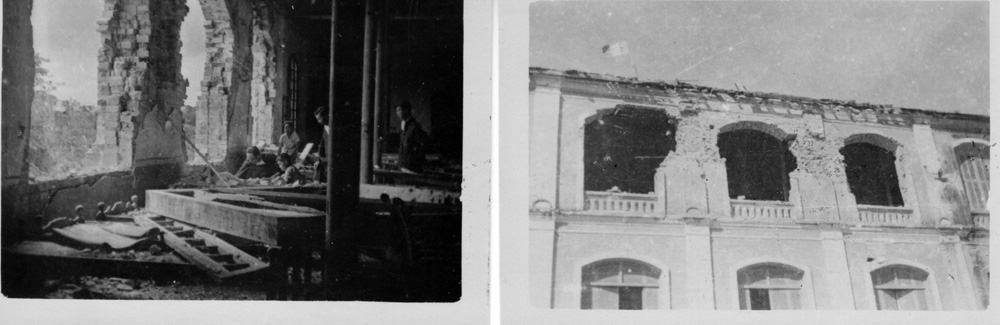
Pellerin, in 1947
Extract from Brother Assistanct Zacharias's Journals (page 149):
"... After the 1945 events, all of our establishments
were closed.
We had tried to push and ecourage to re-open all activities, as soon as
possible.
Finally:
- Taberd re-opened in 1946,
- Pellerin and Puginier in 1948;
- All schools in Nhatrang, Soc Trang and Mytho in 1949.
The number of enrolled students increased very fast..."
Documents 0707 #14: Brother Cyprien,
Visitor, wrote from Saigon, on June 28, 1952:
"... A new challenging event occurs on our Taberd Institution and
menaces putting all our establishments in danger. Yesterday, June 27, I
received an official notice from the government requisitioning the use of
our Taberd Institution as hospital for the Commander in Chief's troupes.
Since there are many other public schools - and private as well, and none of
them is targeted by such a decision. We thus are the frist and easy victims.
... "
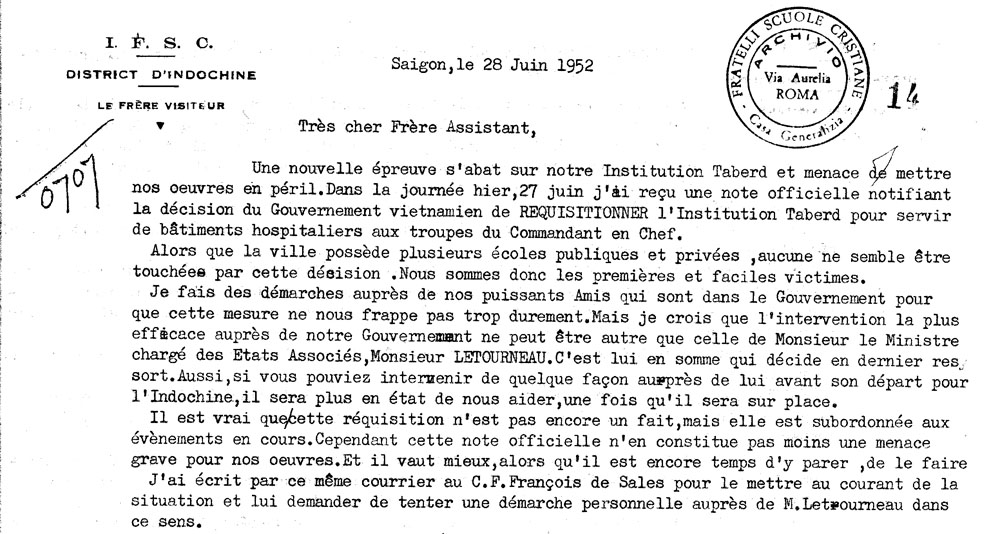
Documents 1807 #15.
"Saigon, July 14,1952
The problem of using Taberd Institution as hospital has not been solved yet,
Brother Cyprien, Visitor, must face another one not so easy to resolve:
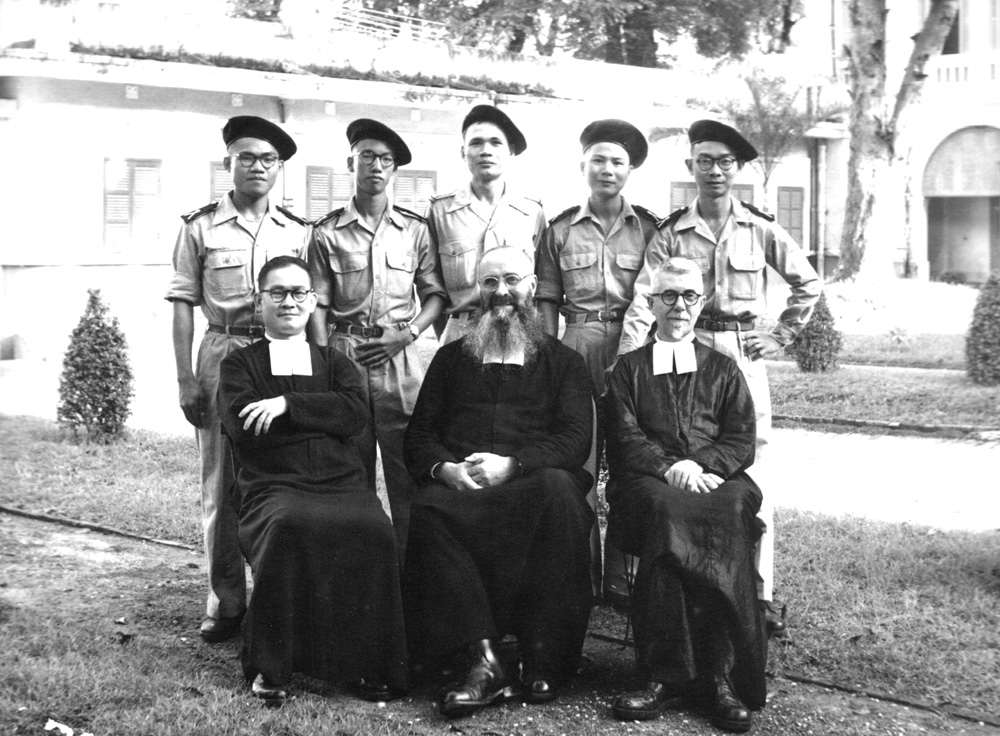
Young Brothers must be mobilized for the military service. Two Brothers of
the Taberd Community and twelve Scholastics...
... "
***
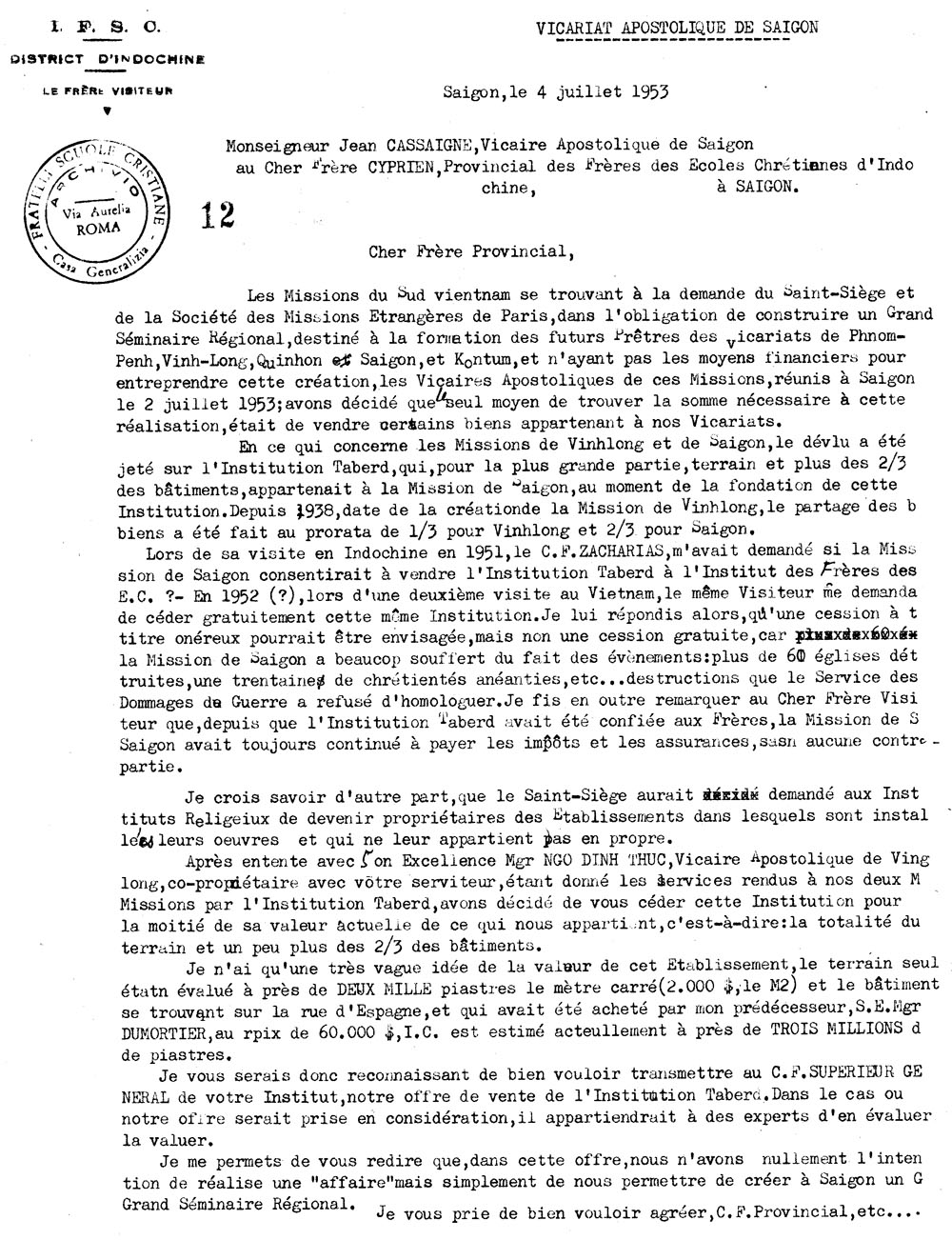
G. Documents 0304 #12.
Saigon, July 4, 1953
Bishop Cassaigne, Apostolic Vicariate of Saigon
to Brother Cyprien, Visitor of the Brothers of the Christian Schools in
Indochina, Saigon.
...
The Missions in South Vietnam accepted the request of Vatican and of the Foreign Missions of Paris, to build a Seminary in the region whose purpose is for the formation to the priesthood in the dioceses of Phnom-Penh, Vinh Long, Qui Nhon, Saigon and Kontum.
The unique financial resources, according to the decision of
the Vicariates gathered in Saigon on July 2, 1953, is to sell out some
properties of the dioceses.
...
On his visit to Indochina in 1951, Brother Zacharias has
asked me about selling out the Institution Taberd to the Brothers of the
Christian Schools. In 1952 (?), during his second visit, the same Brother
Zacharias requested me to donating the Institution Taberd to the Brothers. I
have replied that "dealing it with a reasonable price sounds OK, but totally
donating it to the Brothers... seems impossible, because the Missions in
Saigon have endured too many loss: 60 churches were destroyed, about 30
parishes devastated and closed.
... In addition, I would think important to mentioning it, since the
Brothers have taken over total administration of the Institution Taberd, the
Missions in Saigon have been continuing to pay taxes and insurances.
...
Although I have just unclear idea about the current price
of the establishments, but I do know that the current price of the land is
based on 2,000VNdong by square meter...
..."
***